

Measuring AI success for small business involves tracking concrete financial impacts such as cost reduction and revenue growth instead of focusing on activity or productivity metrics. Business owners must define specific objectives and monitor the return on investment through a structured framework; this approach helps mitigate high failure rates caused by leadership gaps and poor goal setting.
Most Las Vegas business owners treat AI like a slot machine; they pull the lever on a new tool and pray for a jackpot. This haphazard approach explains why 95 percent of AI projects fail to deliver a tangible return. Without a clear framework for success, you are not innovating; you are merely increasing your overhead. To join the successful 5 percent, you must move beyond the hype and master the cold, hard metrics of operational efficiency. This guide introduces a zero dollar framework designed specifically for the local entrepreneur. You will learn how to establish a baseline, identify the three pillars of pre-investment success, and solve the founder dependency problem. We will also quantify the ROI of automated workflows so you can stop guessing and start scaling with precision.
Why 95 Percent of AI Projects Fail and How to Stay in the Successful 5 Percent
Forbes reports a sobering reality for modern entrepreneurs: 95 percent of AI adoption projects fail. Contrary to popular belief, these failures rarely stem from broken code or limited processing power. Research indicates that 84 percent of these projects collapse due to leadership gaps and organizational misalignment; in fact, only 3 percent of leaders are currently prepared for AI-enabled teams. For a Las Vegas small business operating in a high-stakes environment, these statistics represent more than just lost time. They represent wasted capital that could have fueled growth elsewhere.
The most common mistake is prioritizing software over strategy. Many owners confuse AI activity with AI outcomes. Installing a generic chatbot is an activity, but reducing customer support response times while increasing net margins is a measurable outcome. Measuring AI success for small business starts with a fundamental shift in perspective. Success is not found in the tools you buy, but in the specific business problems you solve before paying for your first subscription.
To join the successful 5 percent, you must treat AI as a business decision rather than a technical one. Organizations that define quantified success metrics before implementation see a 54 percent success rate, compared to just 12 percent for those who do not. At ClawDaddy Consulting, we help clients navigate this transition through expert Las Vegas AI consulting, ensuring every implementation is anchored in a professional AI Strategy services framework. Success is ultimately defined by the decisions you make before the first invoice is generated.
The Three Pillars of Pre-Investment Success: Financial, Operational, and Strategic
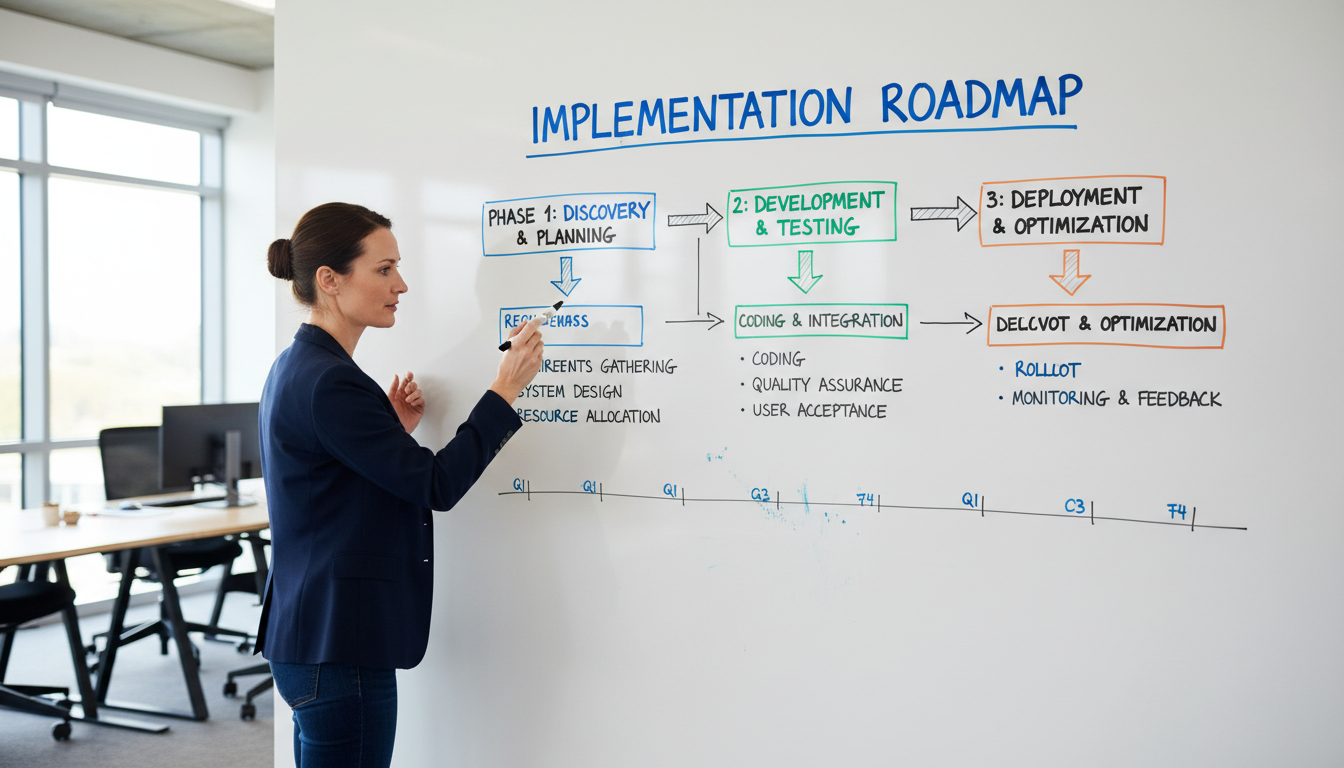
To move from buying software to building a solution, you must categorize your goals into three measurable buckets. These pillars ensure that every technical decision is tethered to a business outcome.
First, consider the Financial pillar. While 88 percent of organizations have adopted some form of AI, only 39 percent see a measurable bottom-line impact. This disconnect occurs when leadership fails to differentiate between cost reduction and revenue growth. However, the data reveals a clear path forward: among organizations that diligently track ROI, 81 percent report positive returns. Before investing, determine if success means reducing administrative payroll by 15 percent through automation or increasing lead-to-close rates by 10 percent through predictive lead scoring.
Second, the Operational pillar focuses on time recovery. This is about quantifying the removal of friction from your daily workflow. Consider a local boutique hotel managing a high volume of guest inquiries. If the staff spends twenty hours a week answering the same questions about valet parking or pool hours, AI success is measured by the percentage of those inquiries resolved accurately without human intervention. This Hours Reclaimed metric is a vital indicator of operational health that directly affects employee retention and service quality.
Third, the Strategic pillar builds a competitive moat. In a 24/7 market like Las Vegas, availability and response speed are the ultimate currencies. Through our Las Vegas AI consulting engagements, we help firms identify where AI creates a barrier to entry for their competitors. For example, a local service business that uses AI to provide instant, accurate quotes while competitors take two days is building a strategic advantage. This is measured by an increase in local market share and customer acquisition speed.
Measuring AI success for small business requires this level of granularity. If you cannot attach a specific number to at least one of these three pillars, you are not ready to sign a subscription contract. Utilizing professional AI Strategy services helps you define these benchmarks early, turning a speculative tech expense into a calculated business investment.
Defining Your Baseline: Measuring Where Your Business Stands Today

Measuring AI success for small business requires a cold, hard look at your current "Zero Dollar" state. Before you evaluate a single vendor, you must document the friction points that currently drain your resources. This begins with a time audit of your most expensive human processes. By identifying where your team spends the most hours on repetitive, cognitive labor, you establish the baseline against which any future tool will be judged.
Consider a legal firm in Summerlin that manually reviews 50 commercial lease contracts every week. This process is ripe for optimization, but they cannot measure improvement without knowing their starting costs. A simple spreadsheet and a commitment to honesty about current inefficiencies are the only tools required for this phase.
Process Step | Weekly Volume | Time per Unit | Total Weekly Hours | Estimated Hourly Rate | Weekly Labor Cost |
|---|---|---|---|---|---|
Initial Document Intake | 50 Contracts | 30 Minutes | 25 Hours | $75 | $1,875 |
Detailed Clause Review | 50 Contracts | 90 Minutes | 75 Hours | $150 | $11,250 |
Formatting and Summary | 50 Contracts | 15 Minutes | 12.5 Hours | $50 | $625 |
Total Baseline Cost |
|
| 112.5 Hours |
| $13,750 |
This data creates a "problem first" roadmap. Instead of looking for generic software, this firm is now searching for a specific solution to reclaim $13,750 in weekly capacity. Our Las Vegas AI consulting engagements often reveal that owners skip this step, leading to investments that solve problems that do not actually impact the bottom line. By documenting these inefficiencies today, you move beyond guesswork and into rigorous AI Strategy services. Without a documented baseline, you are merely guessing at your progress.
Measuring AI Performance: Accuracy and Reliability Metrics
Establishing a baseline for time and cost is only half the battle. To ensure the long term health of your investment, you must shift your focus to reliability. A common question in 2026 remains: how often is AI wrong? The answer depends entirely on your specific implementation and the guardrails you establish. Measuring AI success for small business requires defining a precise error tolerance metric before the system goes live.
Speed is a vanity metric if the output requires constant correction. If an AI agent manages 100 customer queries but provides inaccurate information on ten of them, the resulting reputational damage and human rework negate the initial time savings. A successful deployment utilizes a Hand-off Rate baseline. This metric tracks exactly how many interactions require human intervention to reach a resolution.
Without these quality benchmarks, businesses fall into the trap of shallow adoption. This occurs when a team ignores a tool because they simply do not trust its output. High performers who succeed with AI Strategy services treat accuracy as a non-negotiable KPI. By working with Las Vegas AI consulting experts to set these thresholds early, you ensure that automation actually enhances your operations rather than creating a new layer of oversight. Setting these reliability standards prevents the organizational friction that causes 84 percent of these projects to fail.
The Founder Dependency Problem: Why Leadership is the Ultimate Success Metric
Reliability metrics are meaningless if the technology remains trapped within a single office. Forbes highlights a critical leadership gap where only 3 percent of leaders feel truly prepared to manage AI enabled teams. For many boutique firms in Nevada, the founder is often the only person who understands how to prompt the model or interpret the data. If the knowledge of the system stays exclusively with the owner, the implementation is a failure by definition.
Measuring AI success for small business requires tracking the Adoption Rate. This metric represents the percentage of your staff that utilizes the tool daily for its intended purpose without constant prompting from leadership. High adoption suggests the tool solves a genuine friction point; low adoption indicates a process failure. Since 84 percent of AI project failures originate from organizational issues rather than technical flaws, the success of your investment rests on your ability to lead a cultural shift within your office.
Effective Las Vegas AI consulting focuses on decentralizing this expertise. True success occurs when a junior associate or a front desk manager uses an automated workflow to reclaim two hours of their day. By engaging in professional AI Strategy services, you move away from founder dependency and toward a resilient, AI integrated organization where the technology serves the entire team.
How to Measure ROI for AI Agents and Automated Workflows
Decentralizing expertise is the first step toward genuine ROI, particularly when deploying AI agents designed to handle specific, repetitive workflows. For a firm in Nevada, measuring AI success for small business regarding agents requires a shift from viewing them as simple software to viewing them as digital employees. The primary calculation for agent ROI is the ratio of Tasks Completed compared to Human Hours Freed.
Consider a real estate brokerage in Summerlin or Henderson. If an AI agent qualifies leads 24/7, success is not just that the agent exists. Instead, success is the measurable increase in qualified lead conversion rates compared to the previous manual process. If a human agent previously spent fifteen hours a week chasing cold leads, and the AI agent now delivers five high intent meetings while reclaiming those fifteen hours, the ROI is undeniable. High performing firms that track these specific metrics are four times more likely to succeed than those that do not. By partnering with Las Vegas AI consulting experts, you can build a reporting framework that proves value through hard data. These AI Strategy services ensure that automated workflows translate directly into increased capacity and higher conversion floors.
Why Local Las Vegas Context Matters for AI Benchmarking

Measuring AI success for small business in Southern Nevada differs fundamentally from Silicon Valley standards. In a 24/7 hospitality and service economy, success is defined by immediate availability and response velocity. A local HVAC company or professional service firm does not need a generative art engine; they need a system that ensures a zero percent drop in inquiry response rates during peak demand.
Benchmarking should prioritize metrics like Response Time to Inquiries and Local Market Share growth. Efficiency is not a luxury in the Nevada market; it is a survival trait. Through our Las Vegas AI consulting, we align your technical KPIs with the specific competitive pressures of the Strip and surrounding valleys. Implementing professional AI Strategy services ensures your benchmarks reflect the reality of operating in a town that never sleeps, where being second to respond usually means being last to the contract.
Tracking your progress does not require a massive budget or complex tools. By focusing on simple metrics and clear objectives, Las Vegas small business owners can see exactly how automation impacts their bottom line without spending a dime. If you want expert help refining your roadmap and scaling these initial successes, developing a custom AI Strategy is an excellent next step. Our team is here to ensure your technology investments align perfectly with your unique business goals as you grow.