

Small businesses can build team capabilities by utilizing free online resources and structured programs like Grow with Google or the U.S. Chamber of Commerce. Effective AI training for small business focuses on practical application and clear upskilling goals; this allows teams to gain fluency without a dedicated learning and development department.
Small business owners often feel paralyzed by the rapid evolution of artificial intelligence. You see the enterprise giants deploying dedicated training departments to upskill their workforces, yet your lean team is struggling just to keep up with daily operations. This gap between having access to AI tools and knowing how to extract actual value from them is where many firms lose their competitive edge. Without a structured approach, your staff will likely default to shallow use cases or, worse, compromise sensitive data. This guide provides a practical blueprint for building team capability without a massive L&D budget. You will learn how to identify internal AI champions, curate effective training resources, and implement essential safety protocols. We are moving beyond the hype to focus on the specific strategies that transform your current employees into an AI fluent workforce.
The AI Implementation Gap in Small Business

In Las Vegas, small business owners are witnessing a significant disconnect between AI potential and daily application. While the buzz around generative tools is high, the transition from experimenting with a chatbot to optimizing core operations remains a hurdle. Data from the US Chamber of Commerce reveals that over 70 percent of small business owners believe their organizations need more training to implement AI effectively. This highlights a persistent implementation gap; while 93 percent of users report positive impacts, only 14 percent have fully integrated these tools into their business model.
Large corporations bridge this gap with dedicated Learning and Development departments and a custom AI strategy managed by specialists. A local firm in Summerlin or downtown Las Vegas rarely has that luxury. Instead, the owner or a manager often wears multiple hats, leaving little room for academic study. The objective here is not to hire a full time trainer, but to build a self-sustaining culture of AI literacy. Effective AI training for small business focuses on practical, role specific skills rather than theoretical knowledge. By partnering with Las Vegas AI consulting experts, firms can bypass the steep learning curve. The goal is a lean approach where training is synonymous with focused problem solving, allowing existing team members to become proficient without disrupting the bottom line.
How to Train AI with No Experience: The Curation Strategy
The most common mistake business owners make is attempting to build a custom AI curriculum from the ground up. In a high speed market like Las Vegas, you do not have the time to act as an instructional designer. Instead of creating content, your primary role should be curation. The objective is to identify the most effective existing resources and map them directly to specific business needs to ensure a custom AI strategy actually takes root.
Effective AI training for small business requires a two pronged approach. First, establish a baseline of general AI literacy. This involves understanding what a Large Language Model (LLM) is and the basic logic of how these tools process information. Foundations like the Grow with Google AI Professional Certificate or the US Chamber of Commerce course directory are excellent starting points for this foundational knowledge. These platforms provide structured, vetted information that saves you from the exhaustive task of vetting every YouTube tutorial yourself.
General literacy only goes so far; the second and more critical prong is task specific skill development. This is where curation becomes strategic. Rather than requiring the entire team to take every general course, assign specific modules based on individual roles. A marketing lead in a Henderson retail shop might focus on using Gemini to draft client emails or social copy, while a bookkeeper in a Downtown office might prioritize data analysis workflows in ChatGPT.
Role | Focus Area | Suggested Tool |
|---|---|---|
Customer Service | Drafting responses, tone adjustment | Gemini |
Operations | Process documentation, summarizing meetings | Claude |
Marketing | Content ideation, SEO optimization | ChatGPT |
For a lean team, training should not be viewed as an academic pursuit. It is simply focused problem solving. When an employee spends an hour learning how to automate a repetitive report, that is training. By curating high quality resources and applying them to immediate bottlenecks, you create a learning environment that delivers immediate ROI without the overhead of a formal department.
Creating an Internal AI Champion Program
Moving from curated resources to actual adoption requires a human catalyst. An AI Champion is an existing employee, often the one who naturally experiments with new software or finds shortcuts in Excel. By identifying this person, you shift the primary burden of AI training for small business from the owner to a peer led model. This individual does not need to be a developer; they simply need to be tech curious and willing to share their findings. Their role is to translate general capabilities into specific team wins.
Consider a law firm in Henderson. A paralegal might discover a way to use Claude to summarize three hundred page depositions into five page executive briefs. By empowering this employee to lead, you turn a solitary discovery into a firm wide efficiency. To facilitate this, implement a Show and Tell Friday format. Dedicate fifteen minutes for one team member to demonstrate a specific prompt or tool that saved them at least thirty minutes during the week. This creates a low pressure environment where practical wins are celebrated and socialized across the office.
This peer to peer approach ensures that your custom AI strategy is built on real world usage rather than theoretical ideas. It transforms AI from a management led mandate into a team driven innovation. For firms working with Las Vegas AI consulting partners, the champion serves as the internal point of contact, ensuring that professional guidance is actually applied in the field. This model allows the owner to focus on high level growth while the staff collaboratively optimizes the day to day workflows.
A Practical AI Upskilling Roadmap for Lean Teams
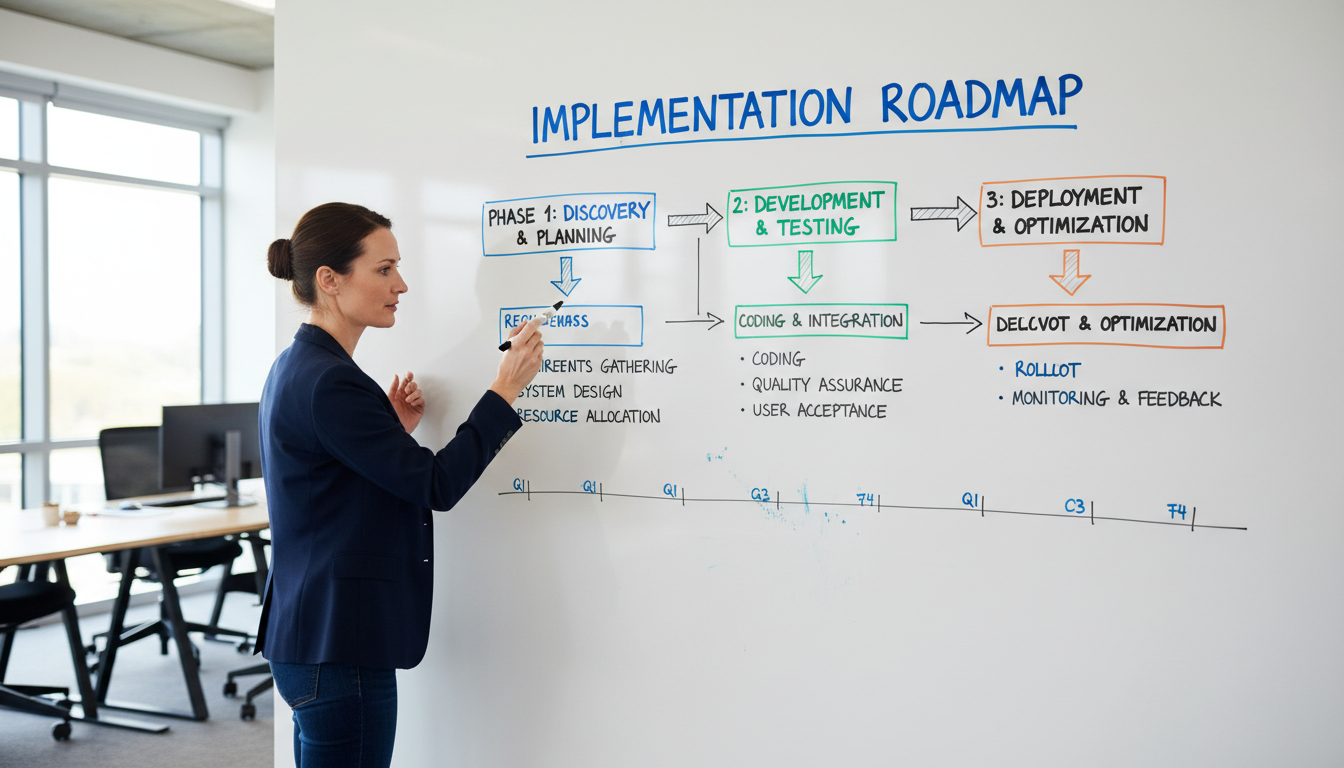
The roadmap for AI training for small business should prioritize immediate operational utility over generic certifications. For a lean team, the objective is to reduce friction in existing workflows, not to add more hours of study to an already full plate. This requires a transition from passive learning to active implementation through a structured, four step framework.
First, perform a task audit. Ask each team member to list three repetitive tasks that consume more than two hours per week. These are your primary candidates for automation. A property management group in Summerlin might identify tenant communication, while a boutique marketing firm might target SEO meta-description generation.
Second, match these tasks to specific, accessible tools based on their core strengths.
Task Type | Recommended Tool | Primary Strength |
|---|---|---|
Complex Logic & Technical Writing | Claude | High nuance and large context windows |
Creative Ideation & General Research | ChatGPT | Versatility and extensive ecosystem |
Data Synthesis & Google Integration | Gemini | Seamless connection to Sheets and Docs |
Third, initiate a two week pilot for a single workflow. During this period, the team member uses their selected tool for that specific task exclusively. This learn by doing methodology prevents the paralysis that often comes from broad, theoretical courses. It forces the user to encounter and solve real world formatting or logic issues in real time.
Fourth, document the results. Create a shared Prompt Library in your company’s internal drive. When an employee finds a specific phrasing that yields the perfect output, they save that prompt for others to use. This ensures that a custom AI strategy becomes institutional knowledge rather than individual expertise.
Successful upskilling must align with specific business goals, such as reducing lead response time or improving document accuracy. Chasing every new trend leads to burnout; focusing on measurable efficiency gains via Las Vegas AI consulting principles ensures your team grows alongside the technology without losing focus on the bottom line.
Essential AI Safety and Cybersecurity Training

Practical AI training for small business must treat security as a primary operational pillar, not a secondary consideration. When a team begins using public large language models, they are often unknowingly uploading proprietary information to third party servers. Public models use input data to improve future performance. This means a secret financial formula, a client’s legal strategy, or sensitive employee records could theoretically resurface in a response provided to a competitor.
To mitigate these risks, a robust custom AI strategy must include clear data governance. Employees need to understand that the convenience of an AI chatbot does not bypass existing NDAs or privacy laws. Security training should emphasize the human in the loop principle, where every output is scrutinized for accuracy and bias before being used in a client facing capacity.
Establishing a baseline for safe usage involves a simple set of guardrails:
Do use anonymized or synthetic data when testing new prompts.
Do check privacy settings to opt out of data training where possible.
Don't paste personally identifiable information (PII) such as social security numbers or private addresses.
Don't upload unredacted internal documents, trade secrets, or proprietary source code.
For businesses handling highly sensitive data, relying on public web interfaces is often insufficient. This is where Las Vegas AI consulting adds specialized value by deploying Private AI instances. These environments provide the same generative power as mainstream tools but within a secure, isolated wrapper that ensures data never leaves the organization. By combining cybersecurity expertise with AI implementation, you protect the business from liability while still capturing the efficiency gains of modern technology.
Overcoming Common Small Business AI Training Obstacles
While interfaces like ChatGPT are designed to be intuitive, true professional application requires a significant shift in mindset. Many owners wonder if they really need formal training to use AI at all. The distinction lies in the difference between casual usage and professional mastery. Anyone can ask a chatbot to write a generic email, but executing a custom AI strategy that automates complex inventory logs or legal filings requires specific technical precision.
Search data shows a high interest in finding a "free course with certificate." While these credentials offer a baseline, a digital badge does not guarantee a return on investment. In the competitive Las Vegas market, a team member who can build a functional automation to handle lead intake is infinitely more valuable than one who merely watched ten hours of video. Prioritize applied skills that solve immediate local bottlenecks over vanity metrics.
The most persistent obstacle is the perceived lack of time. Small teams rarely have the luxury of four hour seminars. To overcome this, replace traditional training with micro learning. Implement five minute daily prompt challenges. Ask your team to use AI to summarize yesterday’s meeting notes or to draft a response to a hypothetical client complaint. These small, repetitive actions build operational confidence without disrupting the workday. For more complex integration needs, Las Vegas AI consulting experts can provide the necessary shortcuts, ensuring your team focuses their limited time only on high impact results.
Empowering your team to use AI does not require massive overhead or a dedicated department. By focusing on practical application and internal champions, you can foster a culture of innovation that scales with your growth. While these steps provide a solid foundation for internal development, navigating the technical landscape can still feel daunting. If you want expert help tailoring a roadmap for your specific needs, exploring a custom AI Strategy is a natural next step. We can help you bridge the gap between initial curiosity and sustainable business results.