

Successful AI implementation for small business requires identifying specific business objectives and prioritizing high-impact use cases that solve immediate problems. Instead of universal automation, companies should empower internal champions to integrate these tools into daily workflows and team habits. This phased approach focuses on measurable time savings and ensures that new technology becomes a sustainable part of the business environment.
Most small business owners feel a mounting pressure to adopt AI, yet they often find themselves staring at an expensive list of software subscriptions that nobody actually uses. The enterprise-level playbooks found online are usually too bloated for lean teams; they prioritize massive infrastructure over the daily operational reality of a boutique or local firm. For a small business, success is not measured by the complexity of the tech stack, but by how effectively the team integrates these tools into their recurring habits. This guide moves beyond the hype to offer a practical roadmap for sustainable implementation. You will learn how to identify internal AI champions, apply the 30 percent rule for setting realistic expectations, and transition from mere tool selection to high-impact workflows. We will also cover essential governance and the specific metrics that prove your AI investment is actually driving growth.
Why the Enterprise AI Playbook Fails Small Teams
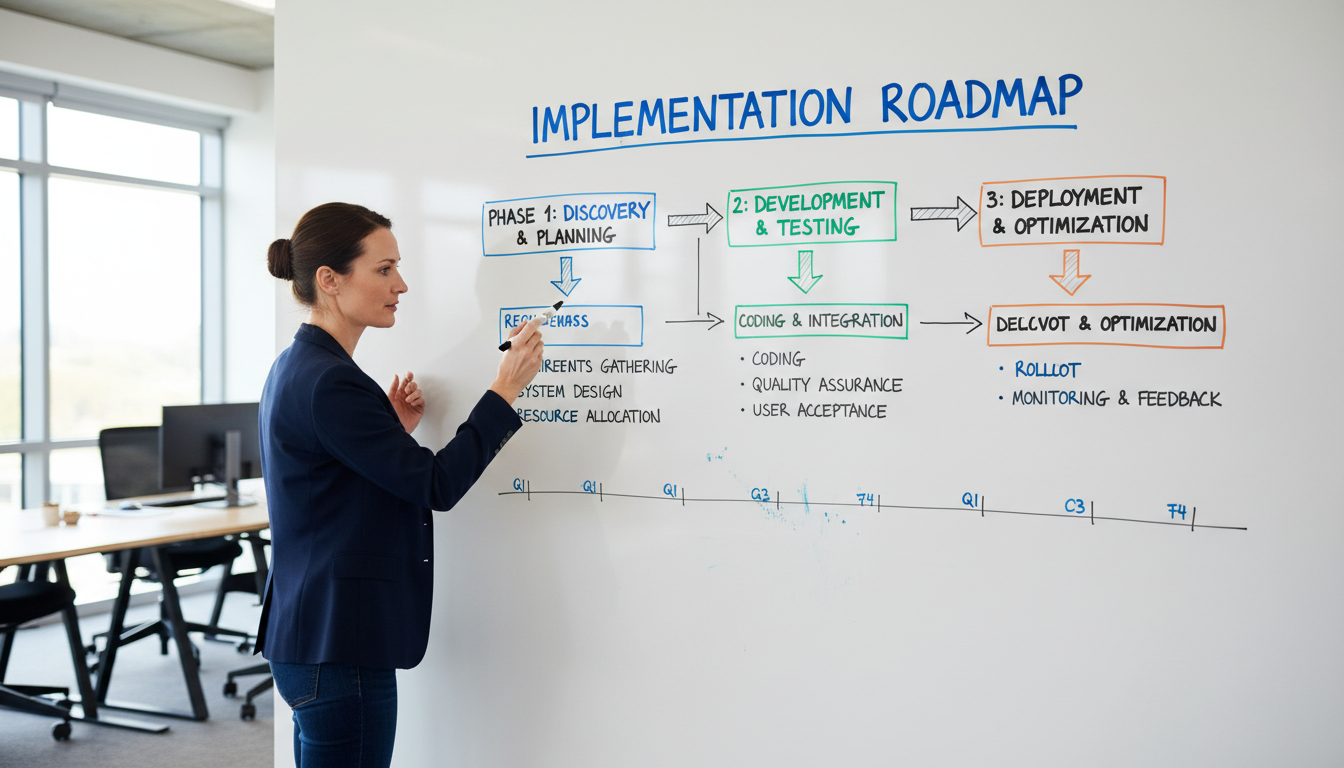
Standard enterprise AI strategies rely on a rigid cycle: setting high-level objectives, cleaning massive legacy datasets, undergoing multi-year procurement, and eventually forcing top-down training. For a local firm, this approach is often fatal to innovation. While large corporations get bogged down in committees, small teams possess a distinct speed advantage, allowing them to deploy solutions in weeks rather than years.
However, many firms squander this lead by treating AI as a one-time software installation. Real success requires a cultural shift rather than a simple purchase. Effective AI implementation for small business involves retraining how your team perceives daily bottlenecks. If you focus only on the hype of new tools, you risk creating expensive, unused digital shelfware. Implementation is not just about the technology; it is about changing how your staff thinks about solving problems.
Instead of chasing every new model, start with a problem-first roadmap. This identifies specific friction points in your operations where automation or intelligence can provide immediate relief. By leveraging Las Vegas AI consulting to map these needs, you can bypass the bloat of enterprise playbooks and focus on practical utility. The goal is to move beyond the setup phase and integrate these AI implementation services into the fabric of your team's workflow.
Identify and Empower Your Internal AI Champions

Transitioning from a roadmap to reality requires a pilot group rather than a company-wide mandate. Successful AI implementation for small business relies on identifying the tinkerers already within your walls. These are the employees quietly using ChatGPT to draft internal memos or Claude to debug a spreadsheet formula for personal efficiency. Instead of imposing a rigid training schedule on the entire staff, identify these organic early adopters and formalize their role as internal AI champions.
Empowering these champions involves more than just verbal encouragement. Provide them with dedicated hours each week, perhaps two to four hours on a Friday afternoon, specifically for experimentation and refinement. Instruct them to document their wins, specifically cases where a prompt or workflow saved measurable time. This creates a pull strategy; when the rest of the team sees a colleague finish a three-hour reporting task in twenty minutes, they will naturally seek to emulate that success. This organic curiosity is far more effective than the push of mandatory, top-down seminars that employees often ignore.
To keep these champions sharp, leverage the local ecosystem. Encourage them to attend Las Vegas AI consulting events or tech meetups at the International Innovation Center @ Vegas. Having your team members participate in industry seminars on the Strip allows them to bring back fresh, battle-tested ideas to the office. By positioning these employees as the internal experts, you build a sustainable knowledge base that scales without the need for constant AI implementation services for every minor update.
The 30 Percent Rule: Setting Realistic Habits for Your Team
Once your internal champions have demonstrated the value of these tools, the focus shifts to broad adoption through the 30 percent rule. A common question among leadership is: what is the 30% rule for AI? Simply put, the objective is to automate or augment repetitive, low-value tasks to reclaim 30 percent of an employee's daily bandwidth. This is not a strategy for headcount reduction; rather, it is a method for increasing high-value output. By offloading administrative burdens, your team can focus on the strategic work that requires human judgment and nuanced client service.
The most effective way to achieve this is through habit stacking. Instead of introducing entirely new software suites that require hours of training, encourage your team to add a single AI-assisted step to an existing manual workflow. This approach makes AI an invisible part of the daily routine rather than a separate, daunting task to learn. For example, a project manager who currently spends an hour writing recaps after client meetings should not be told to start using AI. Instead, the habit is stacked: the manager continues to host the meeting but uses an AI transcription tool to capture the dialogue, generates an initial summary, and then human-edits the final output for accuracy.
This subtle shift transforms a chore into a streamlined process. Success in AI implementation for small business is found in these incremental wins that build over time. When habit stacking is combined with targeted AI implementation services, your firm moves from fragmented tool usage to a cohesive environment where intelligence is baked into every operation. For those looking for local expertise to guide this transition, Las Vegas AI consulting can help identify the specific workflows where these habits will provide the fastest return on investment.
From Tools to Workflows: Practical AI Implementation Ideas
While habit stacking makes the tools familiar, the true return on investment occurs when you move from isolated interactions to integrated workflows. Thinking of AI as a conversational partner is a useful starting point, but treating it as a specialized sub-processor within your existing business pipeline is where AI implementation for small business becomes a genuine competitive edge. The goal is to identify the handoff points where AI handles the heavy lifting of data synthesis and a human provides the final expert oversight.
Consider these three high impact workflows:
Customer Support Augmentation: Instead of a representative starting from a blank screen, an AI tool can scan your internal knowledge base or past tickets to draft a response. The human agent’s role shifts from writing to auditing; they ensure the tone is appropriate and the solution is accurate before hitting send.
Content Repurposing for Marketing: A single piece of long form content, like a blog post or a case study, can be processed by an AI model to generate ten distinct social media snippets, three email subject lines, and a newsletter summary. This preserves your brand’s voice while drastically reducing the time spent on manual formatting and creative fatigue.
Operational Review and Synthesis: Administrative staff can use AI to extract key clauses from vendor contracts or summarize 50 page industry reports into three actionable bullet points. The human handoff occurs during the strategic review of those highlights, focusing energy on decision making rather than dense reading.
Workflow Area | AI Responsibility | Human Handoff Point |
|---|---|---|
Support | Drafting from knowledge base | Final accuracy and empathy check |
Marketing | Formatting and multi-channel variation | Brand alignment and scheduling |
Operations | Summarization and data extraction | Strategic analysis and risk assessment |
Successful integration requires mapping these junctions precisely. An AI implementation consultant for small business can help you identify exactly where the AI should stop and the human should take over to maintain quality control. By refining these specific AI implementation services, you ensure that your team remains the pilot of the technology, not just a spectator. Las Vegas AI consulting provides the tactical blueprints needed to bridge these gaps between raw tools and refined results.
Securing the Habit: AI Policy and Governance for Local Firms

As integrated workflows become second nature, the speed of execution can easily outpace your security protocols. The greatest risk in AI implementation for small business is not the technology itself, but the accidental leakage of proprietary data into public training models. When an employee develops the habit of asking an AI to analyze a spreadsheet, they may inadvertently upload unmasked client lists or sensitive financial projections.
Effective governance starts with a clear, one page Acceptable Use Policy (AUP). This should categorize data using a simple traffic light system: - Green Light: Public marketing copy or general industry research can be shared freely with any tool. - Yellow Light: Internal process documents or meeting notes can be shared only if names and identifying details are redacted first. - Red Light: Personally Identifiable Information (PII), client case files, and trade secrets are strictly prohibited from public LLMs.
For Las Vegas firms in sensitive sectors like estate law or wealth management, protecting client confidentiality is a regulatory necessity. Privacy-first tool selection is critical here. Opting for "Team" or "Enterprise" tiers that offer explicit data opt-outs ensures your inputs are not used to train the provider's global models. Establishing these guardrails does not stall innovation; instead, it provides the team with the confidence to experiment within safe boundaries. By utilizing AI implementation services to audit your tool stack, you ensure that every efficiency gain is backed by robust data protection. For local firms needing a tailored security framework, Las Vegas AI consulting can bridge the gap between high-performance habits and ironclad cybersecurity.
Tracking Success: Metrics That Matter for Growth
The true impact of AI implementation for small business is not measured by the number of active licenses or the frequency of user logins. High seat utilization can often mask inefficient usage or employees struggling to navigate new software without clear direction. Instead, shift your focus to output metrics that reflect tangible growth. If a local marketing team previously required twenty hours to produce two monthly newsletters and now generates four in the same timeframe, the efficiency gain is undeniable.
To maintain momentum, replace top down monitoring with collaborative review. Host a monthly AI wins meeting where team members showcase one specific workflow that has become easier or faster over the last thirty days. This reinforces the habit by focusing on personal relief rather than corporate quotas. When an operations manager demonstrates how a vendor reconciliation task was slashed from four hours to forty minutes, the value becomes self evident to the entire staff.
Metric Type | What to Ignore | What to Track |
|---|---|---|
Engagement | Total login time | Reductions in task completion time |
Productivity | Number of tools used | Total volume of finished deliverables |
Quality | Manual review time | Consistency of output against brand standards |
These qualitative insights, paired with quantitative data on time saved, provide a comprehensive view of your ROI. For firms looking to refine their measurement strategy, Las Vegas AI consulting can help establish a baseline for your current manual processes. Ultimately, these AI implementation services should be judged by how much space they clear for your team to engage in high level strategic thinking. Success is found when the technology stops being a topic of conversation and starts being the engine of your growth.
Turning AI from a theoretical concept into a daily habit requires patience, clear communication, and consistent training. By focusing on small wins and practical workflows, your small business can truly unlock the potential of these tools. If you want expert help navigating this transition, our team can help you build a comprehensive AI Strategy tailored to your goals. This approach ensures your systems remain sustainable, effective, and perfectly aligned with your long-term vision for growth.