

An effective AI strategy for small business focuses on solving specific operational challenges by prioritizing high-impact, low-risk use cases. Small businesses should follow a structured roadmap that emphasizes data readiness and the use of low-code tools to achieve sustainable growth and improved efficiency. This problem-first approach ensures that technology investments directly support core business objectives without requiring extensive technical resources.
Many small business owners feel an urgent pressure to integrate artificial intelligence, yet they often find themselves stuck in a cycle of pilot programs that fail to deliver tangible results. You may have experimented with generic tools only to realize that a lack of direction leads to wasted time and fragmented data. This disconnect occurs because most leaders prioritize the technology over the underlying business problem. To achieve sustainable growth, you must shift your perspective toward a problem-first methodology that treats AI as a strategic lever rather than a magic wand. In this guide, we will move beyond the hype to explore the 10-20-70 framework, conduct a rigorous friction audit, and establish the cybersecurity guardrails necessary for a professional deployment. You will learn how to build a 90-day roadmap that focuses on integration and measurable ROI, ensuring your investment translates into a genuine competitive advantage.
Why Most Small Business AI Strategies Fail Before They Start
Many Las Vegas small businesses begin their AI journey by purchasing individual licenses for tools like ChatGPT or Jasper, assuming the technology will automatically solve operational inefficiencies. This tool-chasing approach is the primary reason why initial attempts at integration often stall. Research from Salesforce indicates that while 78% of small business leaders believe AI will transform their operations, many fall into a strategy gap where they possess the software but lack a measurable return on investment.
For a boutique law firm in Summerlin or a logistics company operating near the airport, AI functions as an accelerant, not a self-contained solution. If you apply high-powered automation to a broken process, you simply reach a bad outcome faster. Success requires moving away from shiny object syndrome and toward a deliberate AI strategy for small business that prioritizes problem-solving over procurement.
Our team provides Las Vegas AI consulting to bridge this gap, ensuring every technological investment aligns with specific business outcomes. Without this strategic foundation, businesses risk leaking sensitive data or creating disjointed workflows that frustrate employees. A proper implementation focuses on the why before the which, transforming AI from an experimental expense into a core driver of sustainable growth. This approach also requires significant cybersecurity expertise to ensure that the data feeding these new tools remains protected from external threats.
The 10 20 70 Rule: The Real Framework for AI Success
Moving beyond the initial hype requires a mental shift in how resources are allocated. A critical framework for this transition is the 10/20/70 rule. This breakdown defines the true components of a successful AI strategy for small business and explains why simple tool adoption is rarely enough to move the needle on the bottom line.
According to this framework, AI success is distributed across three pillars:
10% is the Algorithms: This involves choosing the specific models, such as GPT-4 or specialized machine learning scripts. It is the math behind the curtain.
20% is Data and Technology: This covers your technical infrastructure, clean data pipelines, and the cybersecurity expertise required to ensure your proprietary information does not leak into the public domain.
70% is Business Process and People Transformation: This is the hard work of re-engineering workflows, training staff, and shifting company culture to embrace automated decision-making.
Small businesses often struggle because they flip this ratio, spending 90% of their energy chasing the latest tools while neglecting the people and processes that actually drive revenue. When you focus solely on the 10%, you end up with a collection of expensive subscriptions that no one knows how to use effectively. Our Las Vegas AI consulting methodology prioritizes the 70% first. By identifying how a process is currently failing, we can build the technical foundation needed to support a lasting transformation, ensuring the technology serves the business rather than the other way around.
Step 1: Conduct a Friction Audit to Identify High Impact Use Cases

To address the 70% of success dedicated to business process, you must identify where your daily operations are grinding their gears. This is accomplished through a Friction Audit. Instead of beginning with a list of software capabilities, you must document your existing inefficiencies by looking at where work slows down.
Instruct your department heads to list the top three tasks that consume the most employee time or generate the most frequent customer complaints. These specific friction points represent your highest impact use cases. For a Las Vegas HVAC company, this might involve automating emergency service scheduling during the peak summer months to eliminate manual data entry errors and response lag. A Henderson real estate firm might focus on lead qualification, using AI to vet inquiries against specific criteria before they reach a licensed agent.
Identifying these bottlenecks ensures that your AI strategy for small business addresses actual operational gaps. By narrowing your focus to these high-value areas, our Las Vegas AI consulting team can help you build a roadmap that delivers immediate, tangible results rather than vague promises of efficiency. This audit provides the essential logic for every technical decision that follows.
Step 2: Assessing Data Readiness and Cybersecurity Guardrails

Once you have pinpointed your friction points, you must evaluate the raw material required to solve them. An AI strategy for small business is only as effective as the underlying data feeding the models. For most Las Vegas SMBs, this stage involves moving beyond siloed information to achieve data readiness. This means centralizing customer email threads, cleaning duplicate CRM records, and ensuring internal knowledge bases are structured logically. If your data is messy, fragmented, or outdated, your AI outputs will be at best unhelpful and at worst hallucinatory.
Data readiness is half the battle; the other half is protection. This is where cybersecurity expertise becomes the backbone of your implementation. The most significant risk in rapid AI adoption is the leakage of proprietary information. Employees, in an attempt to be more efficient, often paste sensitive contract language or confidential financial spreadsheets into public versions of large language models. These public tools frequently use input data to train future iterations, effectively moving your private business trade secrets into the public domain.
Mitigating this risk requires firm cybersecurity guardrails and a documented AI Policy. This policy should explicitly state which data types are AI-eligible and which platforms are sanctioned for use. We advise clients to prioritize enterprise grade tools or API-based connections that provide data privacy guarantees, ensuring your inputs are never used for model training. By establishing these boundaries early, you create a secure environment where your team can innovate without compromising client trust or risking a significant data breach. This structural integrity is what separates a professional implementation from a dangerous experiment.
Step 3: Building Your 90 Day AI Strategy Roadmap
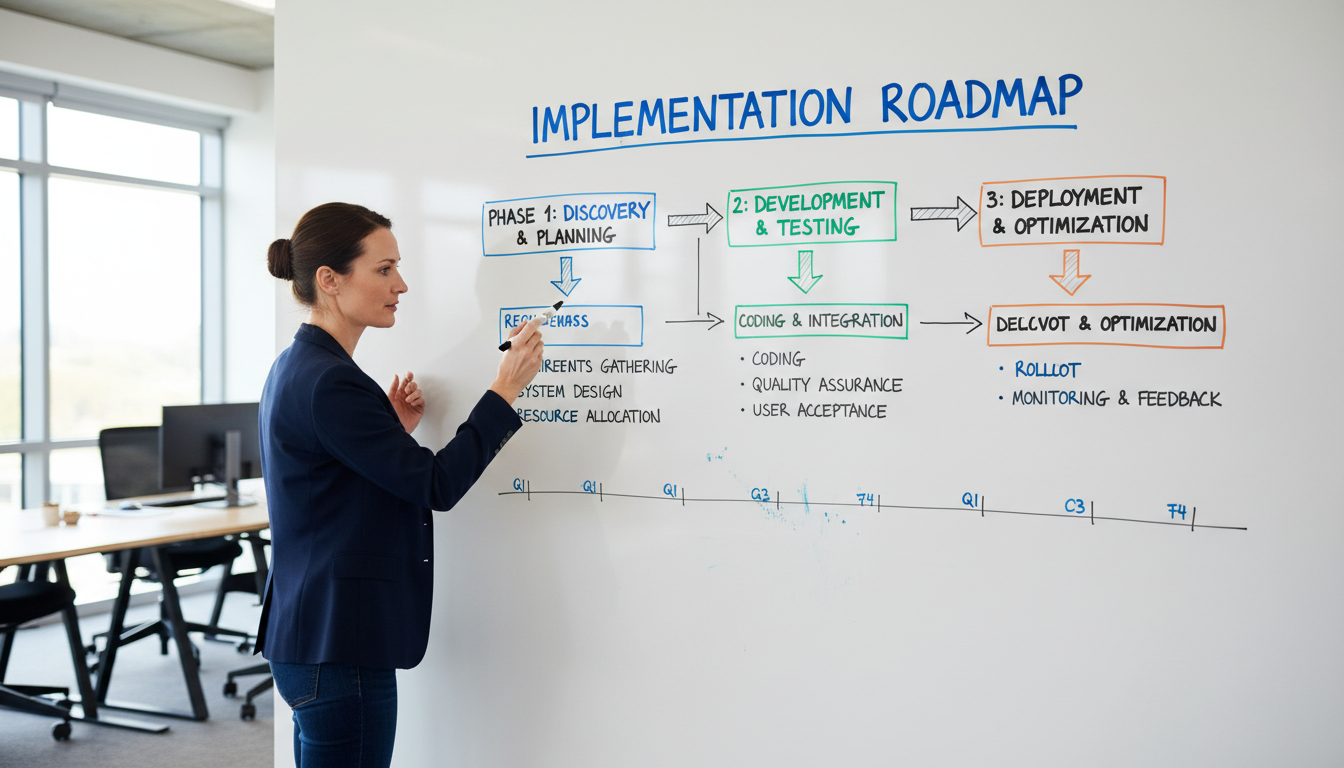
Large enterprises often spend years drafting comprehensive AI frameworks, paralyzed by corporate bureaucracy. Small businesses have a distinct advantage: agility. By following a condensed 90 day roadmap, you can iterate quickly and see results before the next quarter begins. This fast paced approach allows you to adjust to the rapidly changing technological landscape without the overhead of massive consulting contracts.
Month 1: The Pilot Phase Focus on a single pilot program. Select one low risk, high impact tool identified during your friction audit. For many, this is an AI meeting assistant to automate transcription and action items, or a customer service chatbot to handle basic FAQs. This allows you to test the technology without disrupting core operations.
Month 2: Training and Literacy Shift your attention to team wide AI literacy. As established in the 10/20/70 rule, people transformation is the heaviest lift. Provide structured training to ensure your team understands how to prompt effectively and where the cybersecurity expertise and guardrails reside.
Month 3: Measurement and Scaling Conduct a formal assessment of the pilot. Measure the time saved against the tool's cost and scale the implementation to other departments if the ROI is clear. Our Las Vegas AI consulting team specializes in refining these roadmaps to ensure they remain lean and effective. A successful AI strategy for small business does not require a five year plan; it requires three months of disciplined execution and constant feedback.
Step 4: Choosing Tools Based on Integration, Not Hype
Selecting software is the final tactical step in a sound AI strategy for small business. You must distinguish between genuine innovation and AI-washing, where legacy software providers add a superficial chatbot to an old interface and market it as a breakthrough. A robust generative AI strategy prioritizes tools that offer deep integration with your current tech stack, such as Slack, Outlook, or Salesforce. If a tool creates a data silo requiring manual entry, it fails to provide true ROI.
For organizations without a dedicated IT department, prioritize low-code and no-code platforms. These solutions allow you to build custom automations and data workflows through visual interfaces rather than complex programming. However, every new integration represents a potential vulnerability. Our Las Vegas AI consulting team emphasizes that tool selection must include a rigorous review of API security and data handling practices. Utilizing cybersecurity expertise during the procurement phase ensures that your chosen tools work harmoniously with your existing systems without exposing your internal network to new external threats.
Measuring the ROI of Your AI Implementation Strategy
A successful AI strategy for small business requires moving beyond the subjective sense that things are moving faster. To validate your 90 day roadmap, you must track hard Key Performance Indicators (KPIs) that directly impact your P&L statement. A widely accepted benchmark is the 30% rule in AI productivity, which suggests that for a specific automated task, you should aim for at least a 30% gain in efficiency or a corresponding cost reduction to consider the implementation a success.
Metric Category | Specific KPI Example | Targeted Improvement |
|---|---|---|
Customer Service | Average Response Time | 30% reduction in first-response lag |
Sales | Lead Conversion Rate | 10 to 15% increase via faster qualification |
Operations | Administrative Reporting | 5+ hours saved per week per employee |
Our Las Vegas AI consulting team helps clients establish these baselines before deployment to ensure progress is measurable. Furthermore, your ROI calculation must account for risk mitigation. The cybersecurity expertise applied during setup prevents the catastrophic costs of a data breach, which is a vital, if defensive, return on investment. Quantifying these gains transforms AI from a technical experiment into a documented competitive advantage.
Navigating the world of artificial intelligence requires a focused approach that prioritizes your unique business challenges over technical trends. By following a problem first roadmap, you can ensure that every tool you implement drives sustainable growth and real value. If you find the planning process complex or simply want expert guidance to refine your vision, ClawDaddy Consulting is here to support you. We can help you build a comprehensive AI Strategy that aligns with your goals, providing the clarity needed to scale effectively in an evolving digital landscape.