

Small businesses navigate significant AI risks for small business such as data privacy leaks and accuracy issues when they lack formal governance policies. To innovate safely, firms must establish clear guidelines for tool usage and focus on training employees to identify potential security threats. These steps allow small teams to leverage automation while protecting sensitive company information.
You know you need to integrate AI to stay competitive, yet every headline about data breaches and intellectual property theft makes you hesitate. For small business owners in Las Vegas and beyond, the pressure to innovate often collides with the reality that you do not have a dedicated data security team to audit every new tool. This gap creates a dangerous blind spot where efficiency gains could inadvertently lead to catastrophic compliance failures. In this guide, we will analyze the current state of AI adoption heading into 2026 and identify the specific security risks that threaten your bottom line. You will learn which data points must remain strictly off limits for public tools, how to implement a lean AI policy for teams under 50, and how to build a practical risk management roadmap without hiring a single new engineer.
The State of Small Business AI Adoption in 2026
As we enter 2026, data from Goldman Sachs and Digital Applied confirms a striking dichotomy in the marketplace. While 93 percent of small businesses report measurable positive impacts from their implementations, a staggering 77 to 80 percent admit they are winging it without a formal governance policy. This enthusiasm creates a fertile ground for AI risks for small business owners who mistake tool accessibility for operational security.
This lack of oversight has birthed the era of Shadow AI. In this scenario, employees utilize personal ChatGPT or Claude accounts to draft emails, summarize meeting notes, or debug code without administrative approval. When proprietary work product moves through consumer grade accounts, the business loses control over intellectual property and data sovereignty. The data is often ingested back into the public model, effectively leaking trade secrets into the global training set.
There is also a significant gap between surface level experimentation and strategic integration. Most firms use generative tools primarily for basic content creation, yet only 14 percent have successfully woven AI into their core operations or proprietary workflows. While newer firms are adopting these technologies nearly twelve times faster than their predecessors, the absence of a dedicated data team makes risk management more critical, not less. Without internal specialists to vet every prompt or API call, securing expert guidance and services is the only way to prevent integration debt. Navigating this landscape requires moving beyond casual experimentation toward a structured AI Strategy services framework that prioritizes security as much as speed.
Primary AI Security Risks for Small Businesses

Transitioning from casual experimentation to strategic implementation requires a clear-eyed look at the vulnerabilities introduced by unmanaged tools. These AI risks for small business owners often manifest in three categories: data sovereignty, output reliability, and long-term operational flexibility.
The most pervasive error is treating a prompt box like a private notebook. When an employee pastes a spreadsheet of customer emails, internal financial projections, or a confidential product roadmap into a consumer grade AI tool, that data is no longer internal. Public models frequently ingest user inputs to refine future training sets. This means proprietary trade secrets or sensitive client information could inadvertently surface in a competitor’s query response months later, effectively placing your intellectual property into the public domain.
Beyond data leaks, hallucinations represent a direct threat to brand reputation and legal standing. In a professional context, a hallucination is not a harmless quirk; it is a liability. If a customer service bot provides incorrect pricing to a lead or offers inaccurate legal guidance based on outdated regulations, the business may be held responsible for those commitments. Because large language models prioritize linguistic probability over factual accuracy, relying on them for core business logic without human-in-the-loop protocols is a high-stakes gamble.
Risk Type | Business Impact | Primary Mitigation |
|---|---|---|
Data Ingestion | Loss of intellectual property and PII leaks | Use enterprise APIs with zero-retention policies |
Hallucination | Legal liability and reputational damage | Human-in-the-loop verification (HITL) |
Vendor Lock-in | High migration costs and pricing surges | Modular AI architecture and open-source alternatives |
Integration Debt | Workflow disruption and technical fragility | Standardized AI Strategy services |
Small firms also face the danger of integration debt and vendor lock-in. Building entire departments around a single proprietary tool creates a brittle foundation. If a provider changes their terms of service, hikes API pricing, or deprecates a critical feature, the cost of re-engineering those workflows can be devastating. Without expert guidance and services to vet these platforms, businesses often find themselves trapped in expensive, non-transferable ecosystems that disrupt daily operations more than they streamline them.
What You Should Never Share with ChatGPT or Public AI Tools
Understanding what constitutes a safe prompt is the first step in mitigating AI risks for small business operations. When you interact with a public, consumer-facing AI model, you are often entering into an unspoken agreement: your data in exchange for their processing power. Most public models use these interactions to fine-tune future iterations; effectively, any sensitive information uploaded becomes part of the public domain training set.
To maintain data sovereignty, your team should treat the following categories as strictly off-limits for public tools: - Personally Identifiable Information (PII): Customer names, social security numbers, or private contact details. - Internal Financial Data: Non-public revenue projections, payroll spreadsheets, or debt structures. - Unreleased Intellectual Property: Patent drafts, unique source code, or upcoming product specifications. - Client-Privileged Information: Legal documents or proprietary data shared with you under a non-disclosure agreement.
If your workflow requires processing this data, you must move beyond the standard chat interface. Safer alternatives involve utilizing enterprise-grade APIs or walled garden instances that provide contractual guarantees that your data will not be used for training. Implementing these secure environments requires a tailored approach. By seeking expert guidance and services, local firms can deploy private infrastructure where data remains strictly siloed. Transitioning to these controlled environments is a core component of professional AI Strategy services, ensuring that your competitive advantages remain protected while you capitalize on automation.
The Minimum Viable AI Policy for Teams Under 50
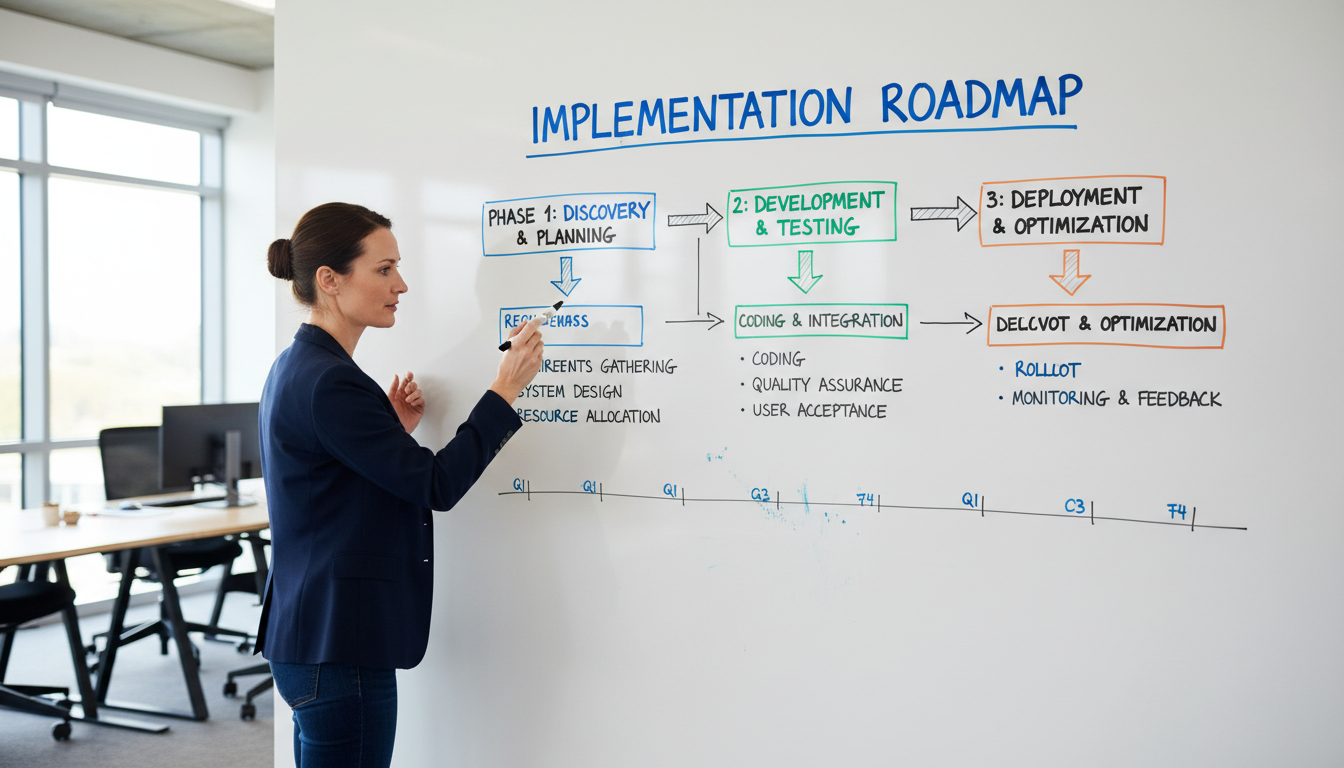
Securing your operations against AI risks for small business does not require a fifty page legal manual that no one reads. It requires a Minimum Viable AI Policy (MVAP). This document serves as a tactical handbook for teams under 50, providing guardrails without stifling the productivity gains often cited as the baseline for successful implementation. A common benchmark in AI circles is the 30 percent rule; while AI can automate 30 percent of a workload, that saved time must be partially reinvested into human oversight to prevent the security gaps discussed previously.
An effective MVAP focuses on four core pillars: - Approved Tool Registry: A living list of vetted platforms where the company has confirmed data privacy settings and enterprise terms of service. - Data Sensitivity Tiers: Explicit instructions on what can be uploaded. For example, marketing copy may be permitted for brainstorming, but PII and client source code are strictly prohibited from public models. - Human-in-the-loop (HITL) Mandate: A requirement that every AI-generated output, from a client email to a line of code, is reviewed and signed off by a human before it leaves the internal environment. - Client Disclosure Protocol: Transparency standards for when and how you inform clients that AI was used in their deliverables.
Rather than a company-wide mandate, the most resilient firms utilize a phased rollout. Start with a single high-impact department, such as marketing or accounting, for a 90 day pilot. This allows the team to identify specific edge cases and refine prompt libraries before expanding to core operations. Navigating this transition requires more than a template; it demands professional AI Strategy services to ensure the policy matches your specific technical stack. Local teams often benefit from Las Vegas AI consulting to conduct the initial risk assessment, turning the MVAP from a static document into a functional defense mechanism. By standardizing these expectations early, you move from the uncertainty of Shadow AI to a position of informed, expert guidance and services oriented growth.
How to Build a Risk Management Roadmap Without a Data Team

Building a roadmap does not require a six figure headcount; it requires a structured approach to risk and reward. The first step is a comprehensive audit of existing usage. Most owners are surprised to find that employees are already using AI for drafting emails or summarizing spreadsheets. By documenting these touchpoints, you identify where the highest AI risks for small business reside, particularly regarding data privacy and intellectual property.
Once the current state is clear, focus your implementation on high-ROI, low-complexity departments. Customer engagement and accounting automation are ideal starting points. These areas offer measurable productivity gains that can fund further security enhancements. When selecting tools, prioritize platforms that provide SOC2 compliance and enterprise-grade data handling. Choosing business-friendly interfaces over consumer-grade ones ensures that your data remains siloed and protected by contract, not just a promise.
Implementation Phase | Key Activity | Goal |
|---|---|---|
Audit | Document all current tool usage | Identify Shadow AI risks |
Selection | Vet vendors for SOC2 compliance | Ensure data sovereignty |
Pilot | Deploy in accounting or support | Validate ROI in 90 days |
Scaling | Formalize AI Strategy services | Standardize company-wide workflows |
For many firms, the gap between winging it and true security is the lack of a resident expert. This is where fractional Las Vegas AI consulting becomes a strategic asset. You can access the specialized knowledge of a Chief AI Officer or Senior Data Architect on a tiered basis, securing your infrastructure without the burden of a full-time salary. This model provides the expert guidance and services needed to navigate complex integrations, ensuring that your risk management roadmap is both professional and sustainable.
Local Las Vegas AI Compliance and Support
Implementing these safeguards requires a nuanced understanding of the Nevada business landscape. A boutique law firm in Summerlin handles different data sensitivities than a high-velocity tech startup in the downtown corridor. While the state regulatory environment continues to evolve, businesses must already account for Nevada specific privacy mandates that govern how consumer data is processed and stored. Mitigating AI risks for small business involves more than just software settings; it requires an alignment with local legal and operational standards.
Operating within the Las Vegas Valley offers a unique advantage for firms seeking Las Vegas AI consulting. Unlike remote vendors, a local firm provides boots-on-the-ground support for hands-on employee training and physical security audits. This proximity ensures that risk assessments are conducted within the context of your specific facility and workflow. Trust and reliability are the pillars of the Nevada professional community. Maintaining those values in a digital era means ensuring that your AI systems do not compromise the client relationships you have built over decades. By leveraging expert guidance and services, you can move from basic experimentation to the deep integration seen in top-tier firms. Developing a secure framework through AI Strategy services allows your business to innovate while remaining firmly grounded in the local standards of excellence.
Implementing AI safely does not require a massive internal data department; it simply requires a thoughtful approach to risk and security. By focusing on clear policies and incremental steps, your small business can compete with larger firms while protecting its valuable reputation. If you feel that navigating these technical and ethical challenges requires a more personalized touch, ClawDaddy Consulting is ready to support you. Developing a robust AI Strategy can help you move forward with confidence. We are happy to assist you in identifying the right tools for your specific goals.