

Small businesses can unlock significant growth by moving beyond basic chat tools to integrate AI agents into high-ROI operational functions. Addressing the challenge of shallow AI adoption small business owners face requires deep technical integration to move past the modest productivity increases currently seen across the sector.
Most small business owners believe they have checked the AI box because they occasionally prompt a chatbot to draft an email or summarize a meeting. This surface level engagement creates a dangerous illusion of progress while your actual overhead and operational friction remain unchanged. While you experiment with basic prompts, your more sophisticated competitors are quietly building integrated systems that automate core workflows. This gap, which we call the 2026 AI Divide, represents the difference between a novelty tool and a genuine profit driver. In this analysis, we will examine why businesses remain stuck at the surface and reveal the hidden costs of stagnant implementation. You will learn how to transition from basic tools to autonomous agents, gain a specific perspective on the Las Vegas competitive landscape, and discover three practical steps to deepen your AI integration today.
The 2026 AI Divide: Understanding Shallow AI Adoption in Small Business
The landscape of AI in 2026 presents a striking paradox. While recent Small Firms Association (SFA) research indicates that over 92 percent of small businesses are utilizing AI, these figures mask a growing problem: shallow AI adoption small business leaders are struggling to overcome. Shallow adoption refers to the widespread use of generic large language models (LLMs) for isolated tasks, such as drafting emails or generating basic content, without deeper technical alignment.
The divide lies between experimentation and integration. Experimentation involves the manual copy-pasting of prompts into a browser, a method that lacks scalability and security. Integration, however, requires connecting AI models directly to proprietary business data to drive specific operational outcomes. Although adoption rates have effectively doubled since last year, organizational confidence remains low. This lag exists because generic tools lack the context of a company's specific workflows, leading to the perception that the technology isn't truly working for the business.
Moving beyond this surface level requires a comprehensive AI strategy that prioritizes data sovereignty and customization. Currently, only 30 percent of firms are taking the step to customize their technology, leaving the vast majority at a competitive disadvantage. For those seeking Las Vegas AI consulting, the priority must be shifting from passive tool usage to active systems that integrate with internal data while maintaining robust cybersecurity for small business.
Why Small Businesses Are Stuck on the Surface of Artificial Intelligence
The stagnation in shallow AI adoption small business owners experience stems from a fundamental categorization error. Many leaders view generative AI exclusively as a marketing tool, a sophisticated version of a copywriter or graphic designer. When the scope is limited to social media posts or email drafts, the technology remains on the periphery of the business. Larger enterprises, specifically those with 250 employees or more, report significantly higher adoption rates, often exceeding 37 percent according to US Census data. These organizations succeed because they treat AI as a core infrastructure project rather than a localized experiment.
Small firms often lack the dedicated technical resources required to bridge this gap. Without an internal engineering team, leaders suffer from hype fatigue, a state of paralysis caused by a market saturated with thousands of specialized tools that promise revolutionary results but offer little guidance on implementation. This choice overload frequently leads to a default reliance on free, public models that do not connect to internal systems. The lack of a clear framework for these tools means that even when a tool is adopted, it remains siloed from the data it needs to be effective.
Bridging this divide requires shifting the perspective of AI from a creative assistant to an operational engine. While enterprise firms have the capital to build bespoke systems, small businesses can achieve similar results through Las Vegas AI consulting that focuses on practical integration. Without this shift, the technology stays in the browser and out of the balance sheet, failing to provide the structural efficiency needed for long term growth. To move beyond this, a firm must transition toward a comprehensive AI strategy that addresses both utility and cybersecurity for small business.
The Real Cost of Surface Level AI Use: Hidden Risks and Lost ROI

The consequences of shallow AI adoption small business owners face extend far beyond missed efficiency; they represent a significant liability. When a firm relies on public, consumer-facing interfaces, it inadvertently creates a massive security vulnerability known as Shadow AI. Employees, eager to meet deadlines, frequently paste proprietary code, sensitive client contracts, or internal financial projections into unauthorized tools. This data is often ingested into public training models, potentially exposing competitive advantages or violating non-disclosure agreements. Without a comprehensive AI strategy, a business is essentially operating its most sensitive logic in a public forum.
This lack of integration also explains the current ROI plateau. Research from Upwork in 2026 indicates that while 74 percent of leaders report productivity improvements, these gains largely stay below the 25 percent threshold. This marginal improvement is the natural ceiling of shallow use. When AI tools are disconnected from your secure databases and workflows, they cannot perform complex reasoning or multi-step operations. They remain isolated assistants rather than integrated engines.
To move past this 25 percent barrier, a business must transition to a secure, private company environment. This shift is where cybersecurity for small business intersects with operational growth. A private instance ensures that data stays within your perimeter while allowing the AI to access the specific context it needs to be effective. Relying on generic tools for professional workflows introduces unnecessary risk without the payoff of significant scaling. For local firms, engaging in Las Vegas AI consulting can help identify where Shadow AI is currently leaking data and how to replace those vulnerabilities with hardened, high-performing internal systems that actually move the needle on profitability.
Transitioning from Tools to Agents: The 2026 Implementation Strategy
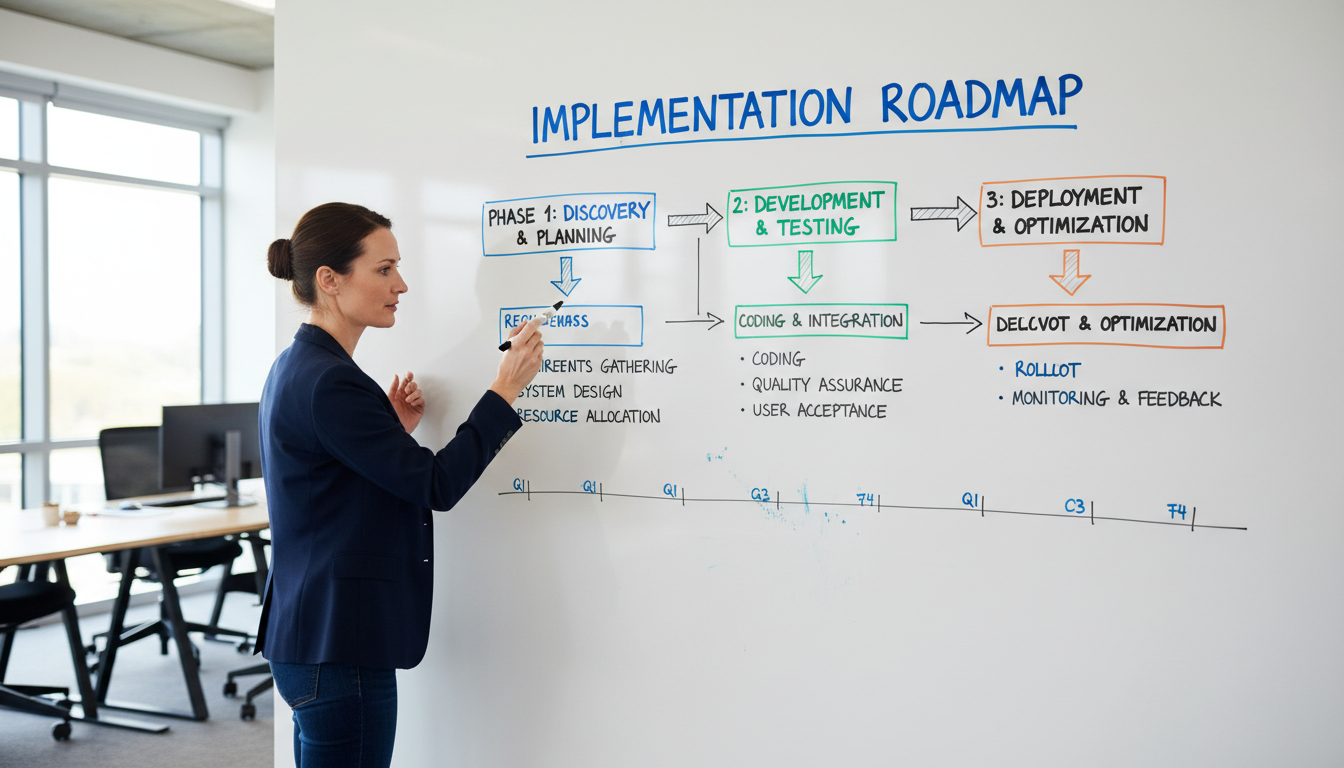
While the productivity plateau is real, 2026 research indicates a strategic shift: SMB leaders are moving their bets from static tools to autonomous AI agents. To overcome shallow AI adoption small business leaders must understand the technical distinction between a chatbot and an agent. A generic chatbot acts as a reactive interface; it requires a human to manually prompt it for every single output. In contrast, a custom AI agent is a goal-oriented system capable of executing multi-step workflows independently by interacting with your existing software stack and proprietary data.
Transitioning to agents allows for high-ROI functions that go beyond simple text generation. Consider the following functional differences:
Function | Generic Chatbot (Shallow) | Custom AI Agent (Integrated) |
|---|---|---|
Lead Management | Drafts a generic follow-up email. | Monitors inquiries, scores leads via CRM, and books meetings. |
Accounting | Explains how to reconcile an account. | Matches bank feeds to invoices in real-time and flags errors. |
Customer Support | Provides links to help documents. | Accesses order history to process returns or update shipping status. |
Moving from asking a question to automating a workflow requires a comprehensive AI strategy. The process begins by identifying repetitive manual tasks where data currently sits in silos. By utilizing Las Vegas AI consulting, firms can map these workflows into agentic frameworks that leverage private APIs. This ensures operations become autonomous rather than just faster. Every implementation must be grounded in cybersecurity for small business to ensure these autonomous agents operate within a hardened, private perimeter.
A Local Las Vegas Perspective on AI Competitive Advantage

In the Las Vegas valley, the AI divide represents a significant competitive opening. While national corporations often struggle with the inertia of rigid legacy systems, local boutique hospitality firms and real estate agencies can move with greater agility. A property management firm in Summerlin that moves beyond the shallow AI adoption small business competitors rely on can automate personalized tenant communications and predictive maintenance using local vendor data. This level of responsiveness is difficult for a national chain operating from a remote headquarters to replicate. By integrating AI directly into the local context, Nevada businesses turn their smaller size into a tactical advantage.
Professional services in Nevada, particularly law and accounting firms, face unique regulatory and security landscapes. Implementing a comprehensive AI strategy requires more than just a software subscription; it demands an understanding of local data privacy expectations and industry specific risks. National AI providers often overlook these nuances, leading to generic implementations that fail to satisfy local compliance. Utilizing Las Vegas AI consulting ensures that your AI agents are built to respect Nevada's specific business environment while maintaining high-tier cybersecurity for small business. For those who choose to integrate rather than just experiment, the current gap in adoption is not a hurdle but a clear path to market dominance.
Three Practical Steps to Deepen Your AI Integration Today
To move beyond the shallow AI adoption small business leaders often settle for, firms must transition from passive users to active architects of their internal intelligence. This progression requires three distinct operational shifts designed to bridge the gap between experimentation and integration.
Conduct a Data Audit: Catalog your proprietary assets, such as transaction logs, customer communications, and project documentation. AI requires high quality context to provide utility beyond generic templates. Identifying where this data lives, and ensuring it is clean and accessible, is the foundation of a comprehensive AI strategy.
Formalize a Security Framework: Replace informal experimentation with a rigid policy. Define which data points, such as client PII or trade secrets, are strictly prohibited from entering public prompts. Establishing these guardrails is essential for maintaining cybersecurity for small business while exploring new tools; it prevents the leakage of intellectual property into public training sets.
Implement Customization: Transition from public web browsers to private environments. By utilizing Retrieval-Augmented Generation (RAG), your firm can ground AI responses in your specific business data within a secure perimeter. This allows the model to act as a specialist rather than a generalist.
These steps shift a firm from the 92 percent of businesses merely dabbling in tools to the 30 percent of innovators who customize their tech stack. For local firms, engaging in Las Vegas AI consulting provides the technical oversight necessary to execute these steps safely and efficiently.
Moving beyond basic chat interfaces allows small businesses to unlock the true potential of automated systems. By integrating AI into your core workflows, you build a foundation for sustainable growth that simple tools cannot provide. If you want expert help navigating these technical shifts, the team at ClawDaddy Consulting is ready to support your transition. You can learn more about our approach to digital transformation. We believe that strategy should always come before software, ensuring your business stays ahead of the competition.