

Small business owners hold ultimate legal and ethical responsibility for any errors, biases, or privacy breaches caused by the technology they deploy. Establishing a clear framework for AI accountability for small business ensures that a human leader remains the final point of verification to mitigate the risks of automated tools.
When an AI tool generates a hallucination or compromises client data, you cannot blame the software. The legal and financial consequences land squarely on your desk; they do not stay with the developer. For small business owners, this reality creates a dangerous gap between efficiency and liability. You need the productivity gains that automation provides, but you cannot afford the fallout of an unmonitored system. This guide bridges that gap by detailing how to establish professional accountability without a dedicated data team. We will examine the core risks specific to smaller operations, navigate the shifting landscape of Nevada privacy laws, and outline a three step framework to secure your operations today. By the end, you will understand how to maintain total control over your digital tools while scaling your bottom line safely.
The Responsibility Reality Check: Who is Actually Accountable for AI Outputs?
Recent data indicates that 57% of small businesses are now investing in AI, yet only 26% report seeing tangible value from those investments. A primary reason for this disconnect is the lack of a defined structure for AI accountability for small business. When an AI tool generates a contract with a legal loophole or an automated customer service response provides inaccurate pricing, the responsibility does not rest with the software vendor. The vendor provides the infrastructure, much like a manufacturer provides a vehicle; however, the business owner remains the driver legally and ethically responsible for where that vehicle goes.
Understanding the distinction between a user and an owner is critical for risk management. A staff member may be a user who inputs data into a model, but the organization is the owner of the resulting output. If that output causes financial harm or a data breach, the liability remains with your firm. Relying on black box algorithms without oversight is not a defense in a court of law or a regulatory audit.
For many firms in Nevada, bridging this gap requires professional AI strategy services. Without a clear framework, you are essentially outsourcing your brand reputation to a third party provider. Our Las Vegas AI consulting team frequently observes that the most successful implementations are those where leadership takes explicit ownership of algorithmic outcomes from day one. By treating AI as a strategic asset rather than a hands-off utility, you protect your business from the accountability vacuum that often follows rapid technology adoption.
Common AI Risks That Small Businesses Often Overlook

Taking ownership starts with identifying where the technology is most likely to fail. Unlike large corporations that maintain dedicated compliance departments to stress-test every deployment, a small firm relies on the owner's vigilance. The most pervasive risk is the hallucination, where a model generates false information with absolute confidence. If an AI-driven marketing tool drafts a promotional email for a Summerlin boutique containing a 50% discount code that was never authorized, the business must honor that error or risk a reputation crisis. The tool is simply predicting the next likely word; it does not understand your profit margins.
Algorithmic bias presents a different, often invisible, threat. If a local service provider uses AI to filter incoming job applications or credit requests, the model may inadvertently mirror systemic biases found in its training data. This can lead to discriminatory outcomes that expose the business to litigation. While a global enterprise might have a team to audit these models for fairness, a small business owner must manually verify that their automated systems are not unfairly excluding specific demographics or neighborhoods.
Finally, data privacy leaks occur when sensitive information is treated as public domain. Uploading a proprietary client list or a confidential legal settlement into a standard, non-enterprise AI model effectively hands that data over to the provider for future training. This breach of trust is often irreversible. Establishing AI accountability for small business requires acknowledging that every prompt is a data transfer. Our Las Vegas AI consulting team emphasizes that while the convenience of these tools is high, the cost of a single leaked trade secret or an automated piece of bad legal advice can be catastrophic. Vigilance is not about technical mastery; it is about rigorous oversight of the outputs that define your professional reputation. Engaging in AI strategy services can help identify these blind spots before they manifest as costly liabilities.
Governance Without a Data Team: Establishing a Small Business AI Framework
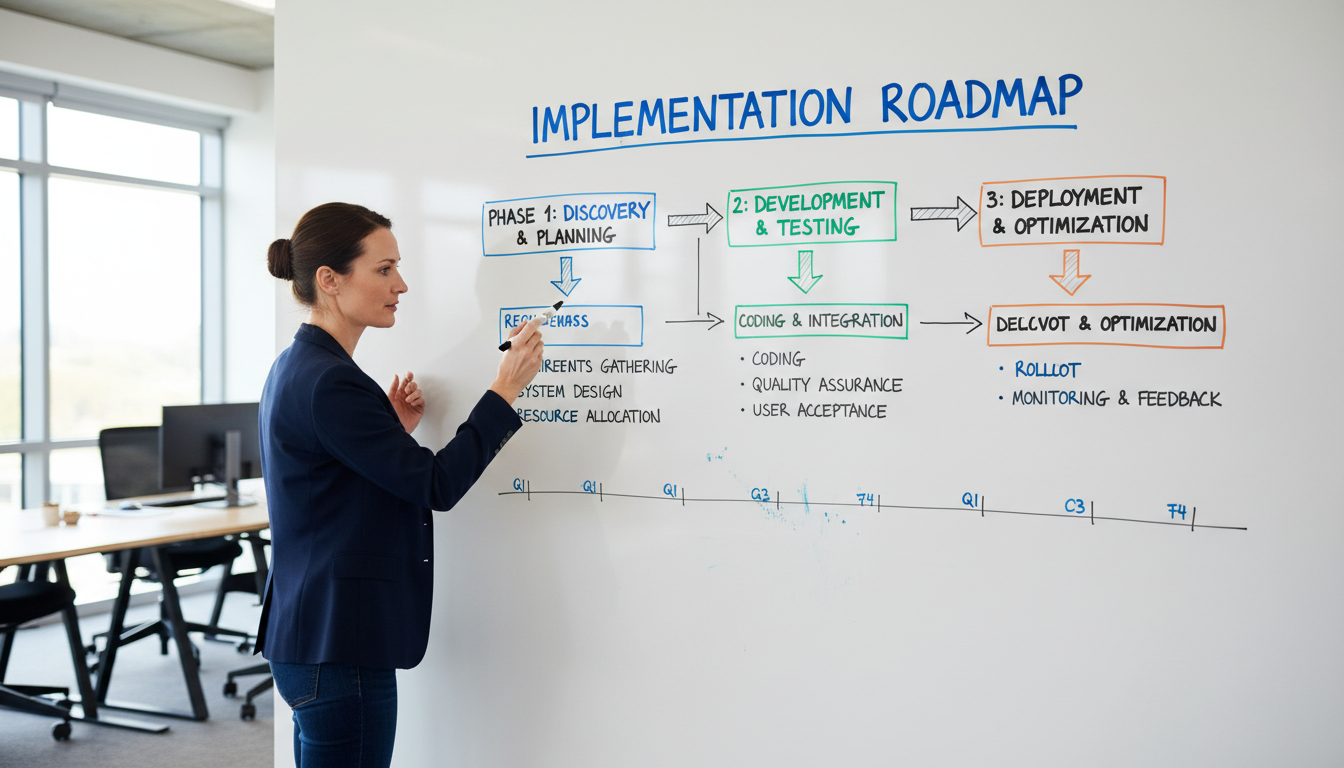
Governance does not require a sprawling IT department or a specialized executive hire. For most Las Vegas firms, the owner or a trusted operations lead must assume the mantle of strategic oversight. A Governance-Lite model focuses on high-impact controls that minimize risk without stalling productivity. This approach ensures that AI accountability for small business is baked into daily operations rather than treated as a distant corporate concept.
This framework rests on three non-negotiable pillars: Transparency, Verification, and Data Hygiene. Transparency involves disclosing where AI is utilized in your workflow. If an automated tool drafts your initial project estimates, your team and your clients should understand that baseline. Verification requires a strict human-in-the-loop mandate. No raw AI output should reach a client or a public platform without a manual review for accuracy and brand alignment. Data Hygiene is the final defense, requiring a clear categorization of what information is safe for public models and what remains strictly local.
Even a three-person team requires a written AI Acceptable Use Policy. This document serves as the operational handbook for your AI strategy services implementation.
Policy Component | Actionable Step for Small Teams |
|---|---|
Approved Tool List | Inventory all software to prevent Shadow AI. |
Prohibited Data | Ban the upload of client PII or sensitive financials. |
Accountability Log | Track who reviewed the final output of an AI task. |
Effective governance is less about complex software and more about disciplined management. By formalizing these expectations, you bridge the gap between adopting a tool and mastering it. Our Las Vegas AI consulting team notes that firms with even a one-page policy see significantly fewer security incidents and higher quality outputs compared to those operating on unwritten assumptions.
Navigating Privacy Laws and AI Regulations in Nevada and Beyond
Legal compliance in the age of automation is often misunderstood as a future problem. While federal legislation specifically targeting artificial intelligence remains in flux, existing frameworks like the Nevada Privacy Law (NRS 603A) already dictate how you must handle consumer data. For a firm operating out of the Vegas Valley, utilizing a third party tool like ChatGPT or Claude does not grant an exemption from these statutes. If you feed customer names, addresses, or purchase histories into a public model to generate marketing insights, you may be in violation of data security requirements if that information is not properly protected or if a consumer has exercised their right to opt out.
Establishing AI accountability for small business requires an understanding that local regulations often mirror broader standards like the CCPA or GDPR. Even if your physical footprint is strictly in Clark County, your digital footprint may trigger these stricter regulations if you serve clients across state lines or overseas. Our Las Vegas AI consulting team advises owners to perform quarterly audits of the data being ingested by their AI tools. You must verify exactly what is being fed into these models and ensure that sensitive identifiers are stripped before processing. By integrating these compliance checks into your AI strategy services, you transform a potential legal liability into a documented standard of care that protects your firm from regulatory scrutiny.
How to Measure AI ROI While Maintaining Control
Measuring financial impact requires moving past the novelty phase. Data suggests that while 57% of firms are investing in these tools, only 26% report seeing tangible value. When evaluating how to measure AI ROI, small business owners must calculate the value of risk mitigation, or the cost of errors avoided. High returns depend entirely on high accountability. A tool that produces fifty emails in one minute is a liability, not an asset, if five of those emails contain incorrect pricing that your team must later explain to Clark County customers.
A practical tracking method involves comparing the time spent reviewing AI work against the total time required for manual production. If your team spends more time verifying a chatbot’s output than they would have spent drafting the response themselves, the implementation is failing.
Performance Indicator | Manual Baseline | AI-Augmented Workflow |
|---|---|---|
Production Time | 120 Minutes | 10 Minutes |
Review & Verification | 10 Minutes | 40 Minutes |
Net Time Saved | 0 Minutes | 70 Minutes |
Error Mitigation Cost | Low | Variable |
Refining your AI strategy services allows you to widen this gap. Our Las Vegas AI consulting experts focus on optimizing these ratios, ensuring that automated efficiency never compromises the strategic control necessary for professional growth. Profitability is found in the balance between speed and the disciplined oversight that prevents costly hallucinations.
Three Steps to Secure Your AI Operations Today

Securing your operations is a function of disciplined management, not coding expertise. Even as 57% of small businesses invest in these tools, many fail to integrate them safely. To solidify AI accountability for small business, you can implement three immediate, non technical safeguards.
Audit for Shadow AI: Conduct a comprehensive inventory of all tools currently used by your team. If a staff member is using a personal account for a specific task, you lack oversight of that data. Establish an approved software list to regain control and ensure every platform meets your firm's security standards.
Mandate Human-in-the-Loop Review: Require a final manual check for all public-facing or client-bound content. This process ensures that hallucinations or brand inconsistencies are caught before they reach a customer, protecting the firm from errors that simple automation might miss.
Define Data Redlines: List specific categories of sensitive information, such as client Social Security numbers, proprietary project files, or internal financial projections, that must never be uploaded to third party platforms.
Applying these steps provides a foundation for more advanced AI strategy services. By formalizing these boundaries, you ensure that your Las Vegas AI consulting efforts lead to scalable growth rather than unmanaged risk. The goal is to move from merely using tools to fully integrating them into a secure, predictable workflow.
Navigating the complexities of AI accountability is a vital part of modern leadership. While these tools provide remarkable efficiency, the ultimate responsibility for every automated decision remains with the human business owner. Establishing clear oversight and internal policies is the most effective way to safeguard your reputation. If you want expert help building a framework that ensures both safety and growth, exploring a dedicated AI Strategy can provide the necessary guidance. We can help you integrate these powerful technologies with confidence and precision.