

Small companies can establish a robust AI policy for small business by assigning internal ownership, documenting specific use cases, and implementing clear security guidelines. Rather than hiring a full compliance team, businesses should focus on regular review cycles and continuous employee training to manage risks and protect data privacy. This framework ensures responsible innovation while maintaining legal standards and customer trust through transparent usage policies.
Most small business owners know their staff is already using generative tools behind the scenes, yet they feel paralyzed by the absence of a dedicated legal department to write the rules. You are likely worried about sensitive data leaking into training models or losing ownership of your intellectual property; however, you cannot afford to stall innovation while waiting for a compliance team that does not exist. Ignoring these risks will not protect your assets. It only leaves your operations vulnerable to security breaches and shifting regulations. This guide provides a practical blueprint for building a governance framework using the resources you already have. You will learn how to establish an internal oversight board, maintain a functional use case registry, and navigate Nevada specific privacy laws. We will also provide a sample policy to help you implement sophisticated oversight without the corporate overhead.
Why Your Small Business Needs an AI Policy Today

Many small business owners in the Las Vegas Valley view artificial intelligence as a future project, unaware that their employees are likely already using platforms like ChatGPT or Claude to streamline daily tasks. This "Wild West" of unauthorized tool adoption creates a significant security vacuum. Research indicates that 11% of data pasted into generative AI tools is confidential, ranging from sensitive client financials to proprietary internal strategies. In a city defined by fast-paced growth and rapid scaling, failing to establish an AI policy for small business isn't a neutral stance; it is effectively a policy of high risk.
Local firms often accumulate technical debt when they prioritize speed over security, making expert AI strategy services essential for sustainable expansion. If your team is inputting operational data into consumer-grade tools without a governing framework, you are essentially outsourcing your data privacy to an external provider without a contract. Choosing to ignore these shadow AI practices does not stop them; it only ensures you have no oversight when a leak occurs. Addressing these vulnerabilities through Las Vegas AI consulting ensures that innovation does not come at the cost of your firm’s intellectual property or regulatory standing.
The Three Pillars of Practical AI Governance
Moving from the identification of risk to active management requires a structured framework. Effective governance does not necessitate a dedicated compliance department; rather, it relies on three foundational pillars that define how your team interacts with machine intelligence.
The first pillar is Data Privacy. Small businesses must distinguish between consumer-grade and enterprise-grade tools. Free versions of popular chatbots often treat your inputs as training data, potentially exposing your trade secrets to the broader model. Enterprise-grade solutions typically provide siloed environments where your data remains your own and is excluded from future model training. Your AI policy for small business should strictly prohibit the use of consumer-grade tools for any task involving PII (Personally Identifiable Information) or sensitive client records. For firms handling high-value transactions, investing in expert AI strategy services can help identify which platforms offer the necessary encryption and data isolation.
The second pillar is Output Accuracy. Large language models are designed for fluency, not necessarily factual precision. They are prone to hallucinations, which are instances where the AI generates incorrect information with high confidence. To mitigate this, implement a mandatory human-in-the-loop review process. No AI-generated content, financial projection, or technical advice should leave your firm without a qualified staff member verifying its validity. Accuracy is a variable, not a guarantee, and your internal documentation should reflect this reality.
The third pillar is Human Accountability. This centers on the Who Owns the Mistake concept. In a small team, it must be clear that the person utilizing the tool is ultimately responsible for the final output. If an automated script causes a billing error or a generated social post violates a trademark, the blame cannot be shifted to the software. By establishing clear lines of ownership through Las Vegas AI consulting, you ensure that AI remains a tool for augmentation rather than an excuse for negligence.
How to Create a Living AI Use Case Registry
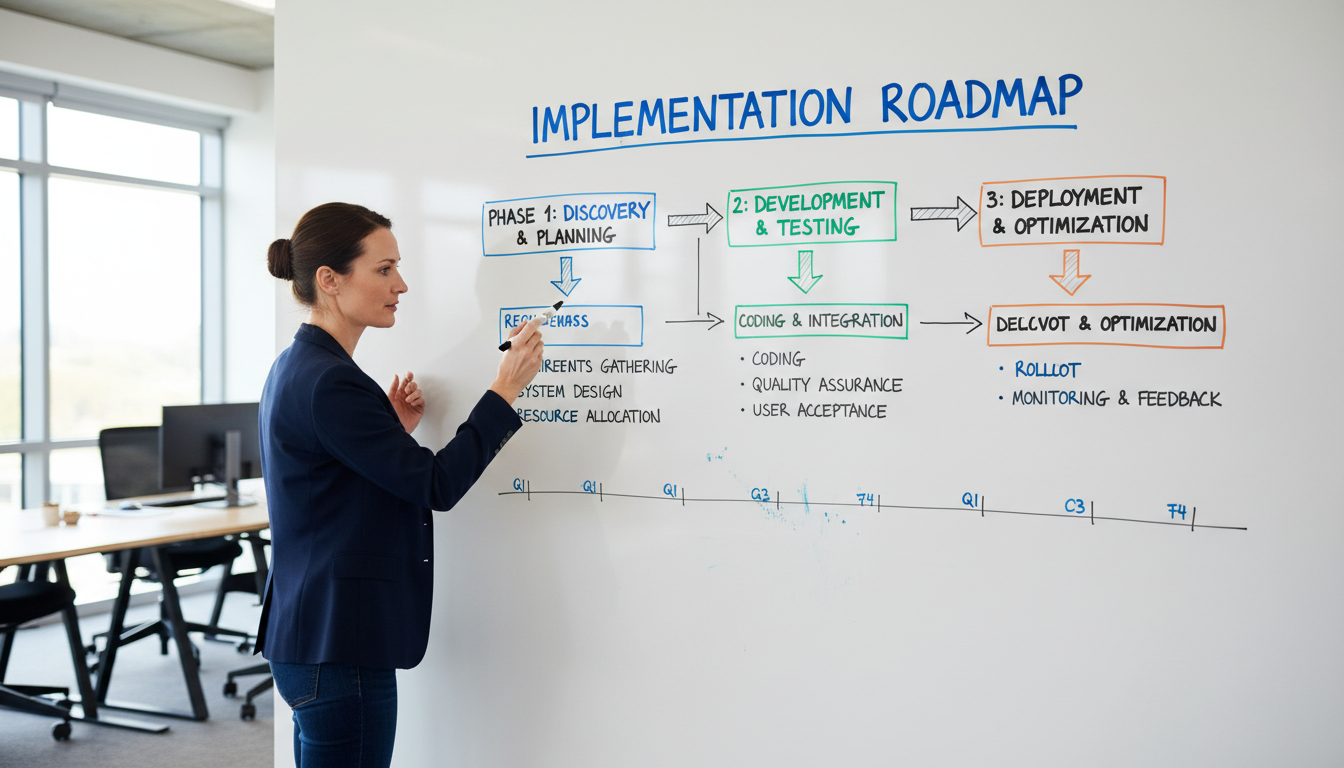
Establishing accountability starts with visibility. You cannot govern what you do not track. The most effective way to gain this oversight without a six figure compliance budget is to create a Living AI Use Case Registry. This is a simple, shared spreadsheet that serves as the central record for every way machine intelligence is deployed within your firm.
Start by auditing your current workflows. Ask your team to document every instance where they use an AI tool, even for minor tasks like drafting emails or summarizing meeting notes. This document should be accessible to everyone and updated in real time as new tools are tested. By centralizing this information, you transform your AI policy for small business from a theoretical document into a practical management tool.
For each entry, capture these four critical data points:
Field | Purpose |
|---|---|
Tool Name | The specific platform (e.g., ChatGPT Plus, Claude Pro). |
Specific Task | The exact business process being assisted (e.g., Drafting initial client proposals). |
Data Types Accessed | Categorize the sensitivity (e.g., Public marketing copy vs. Internal operational data). |
Responsible Party | The specific employee who reviews and approves the final output. |
This registry allows you to spot tool sprawl before it becomes a security liability. If you find multiple departments using different tools for the same task, you can consolidate them into a single enterprise grade solution through expert AI strategy services. Regularly reviewing this registry during monthly check ins ensures that your Las Vegas AI consulting efforts remain grounded in actual usage rather than assumptions.
Data Privacy and the Opt Out Strategy
Once your registry identifies the tools in play, the next step is securing the data flowing through them. The primary concern for most firms is the risk of sensitive inputs being ingested into a public model’s training set. For common tools like ChatGPT, users can often find a toggle in the settings menu under Data Controls to opt out of training. This simple step prevents your specific prompts from appearing in future iterations of the tool’s knowledge base. However, relying on manual toggles is not enough for a robust AI policy for small business.
As you integrate AI more deeply into your operations, you must shift your focus toward vendor due diligence. Many software providers now market AI-powered features, yet they remain opaque about data residency. Use the following table to vet potential partners before granting them access to your proprietary information.
Question for Vendor | Significance |
|---|---|
Is our data siloed? | Ensures your data is isolated in a private environment, not a shared pool. |
Is the model fine-tuned on our inputs? | Confirms that your trade secrets aren't being used to improve the base model. |
Where is the data physically stored? | Addresses compliance with domestic or international data residency laws. |
Who has administrative access? | Defines the human perimeter surrounding your information. |
In the high stakes environment of the Las Vegas business community, where data breaches can lead to massive reputational damage, these technical details are critical. Treating AI endpoints with the same rigor as your firewall or VPN is central to Las Vegas AI consulting. By implementing a proactive opt out strategy, you ensure that expert AI strategy services provide a competitive advantage without compromising your cybersecurity posture.
Building an AI Governance Board with Your Existing Team

Small business owners often stall on governance because they believe it requires a dedicated compliance officer or a six-figure budget. In reality, effective oversight is best achieved by deputizing the people already embedded in your workflows. For a lean Las Vegas firm, a functional AI Governance Board consists of just three key perspectives: a lead from operations, an IT representative (or your expert AI strategy services partner), and a frontline power user.
This group should meet once a month for no more than forty-five minutes. Their primary directive is to audit the Use Case Registry mentioned previously, ensuring that every tool in play aligns with the firm’s security posture. By including a frontline user, the board gains visibility into shadow AI or tool sprawl that leadership might otherwise miss. The IT or Las Vegas AI consulting lead provides the technical guardrails, while operations ensures the technology actually serves the bottom line.
The board’s role is not just to restrict, but to adapt. As generative models evolve, this team updates the AI policy for small business to reflect new capabilities or emerging risks. This dynamic approach ensures your governance remains a living framework rather than a stagnant document, allowing your team to scale safely without the overhead of a full compliance department.
Sample AI Policy for Employers: Key Clauses to Include
The governance board’s first practical output should be a document that employees actually read and apply. A functional AI policy for small business avoids fifty pages of dense legal jargon, focusing instead on four core clauses that define daily operational boundaries. This lean guide serves as the definitive manual for tool interaction, ensuring that efficiency gains do not compromise security.
Clause Section | Essential Requirements |
|---|---|
Purpose | Define AI as a tool for augmentation. State that machine output never replaces human judgment or final accountability. |
Acceptable Use | Reference the Use Case Registry. Explicitly list which platforms are approved for specific tasks like brainstorming or coding. |
Prohibited Data | Create a hard ban on inputting PII, client financials, or unreleased trade secrets into any consumer-grade tool. |
Disclosure | Establish clear triggers for when a client must be notified that AI was used to generate or influence a deliverable. |
Transparency is vital for firms utilizing Las Vegas AI consulting. If a client expects bespoke human analysis, using a model to generate their report without disclosure can lead to severe reputational friction. By codifying these expectations, you move from vague warnings to concrete standards. For firms struggling to define these boundaries, expert AI strategy services can help customize these clauses to fit specific industry regulations and departmental workflows.
Nevada Specific Privacy Considerations for AI Users
Operating in the Mojave means adhering to specific state mandates. Your AI policy for small business must account for Nevada Revised Statutes, specifically SB220, which gives consumers the right to opt out of the sale of their personal data. Many AI platforms operate in a legal gray area regarding data ownership; if your tool transmits Nevada resident data to a third party for model training or secondary use, it might constitute a sale under state law.
Local firms should engage Las Vegas AI consulting to audit these data flows. Ensuring compliance requires more than a generic template. It demands expert AI strategy services that align your automated workflows with Nevada’s rigorous consumer data protection requirements and evolving privacy standards.
Building a governance framework is about creating clear guardrails that empower your team rather than slowing them down. By focusing on transparency and regular reviews, you can manage risks effectively even without a dedicated compliance department. If you want expert help tailoring these principles to your unique business needs, ClawDaddy Consulting is here to guide you. Defining a clear AI Strategy provides the foundation for sustainable growth and ethical innovation, helping you navigate the future with confidence.